What Is a Disposable Vape? How It Works and What’s Inside

What Is a Disposable Vape? How It Works and What’s Inside
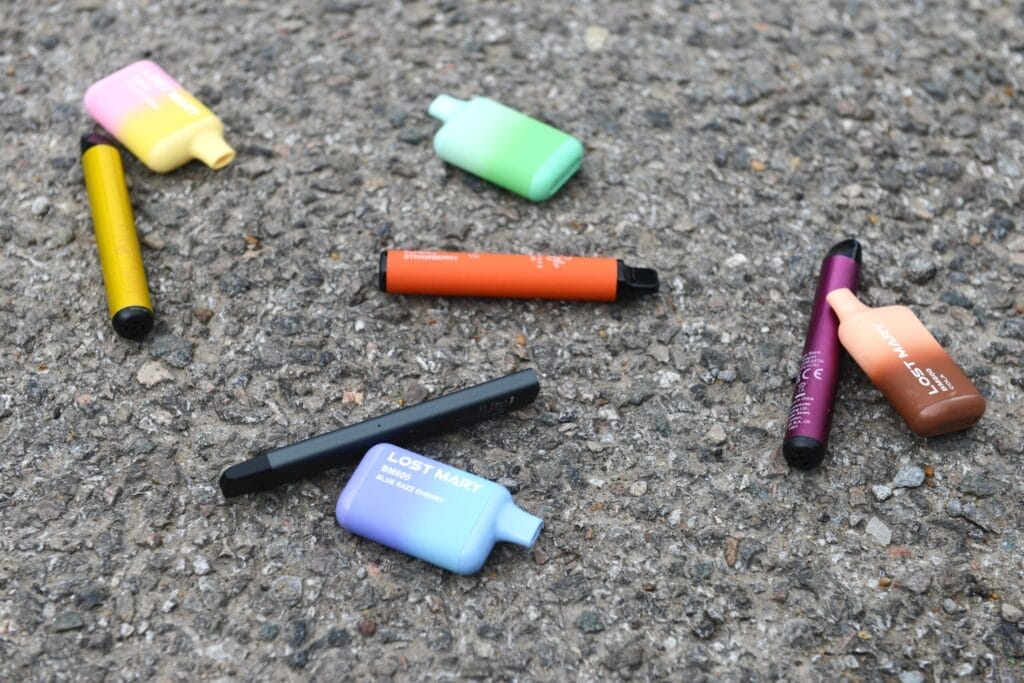
Electronic vapourisers have evolved significantly over the past decade, moving from bulky, complicated rebuildable devices to compact, user-friendly formats. At the centre of this shift is the disposable vape, a self-contained device engineered for ultimate simplicity and immediate use. Unlike traditional setups that require separate tanks, replacement coils, and external e-liquid bottles, these all-in-one units come pre-charged and pre-filled, ready to deliver vapour straight out of the packaging.
Understanding how these compact units function requires looking past their sleek outer casing. Beneath the colourful exterior lies an integrated system combining electro-mechanical sensors, miniature lithium power cells, thermal heating elements, and formulated chemical solutions. Whether you are curious about the mechanical principles behind modern vapourisation or want to know exactly what compounds make up the aerosol, this guide explores the design, internal engineering, and scientific operation of single-use vapourisers.
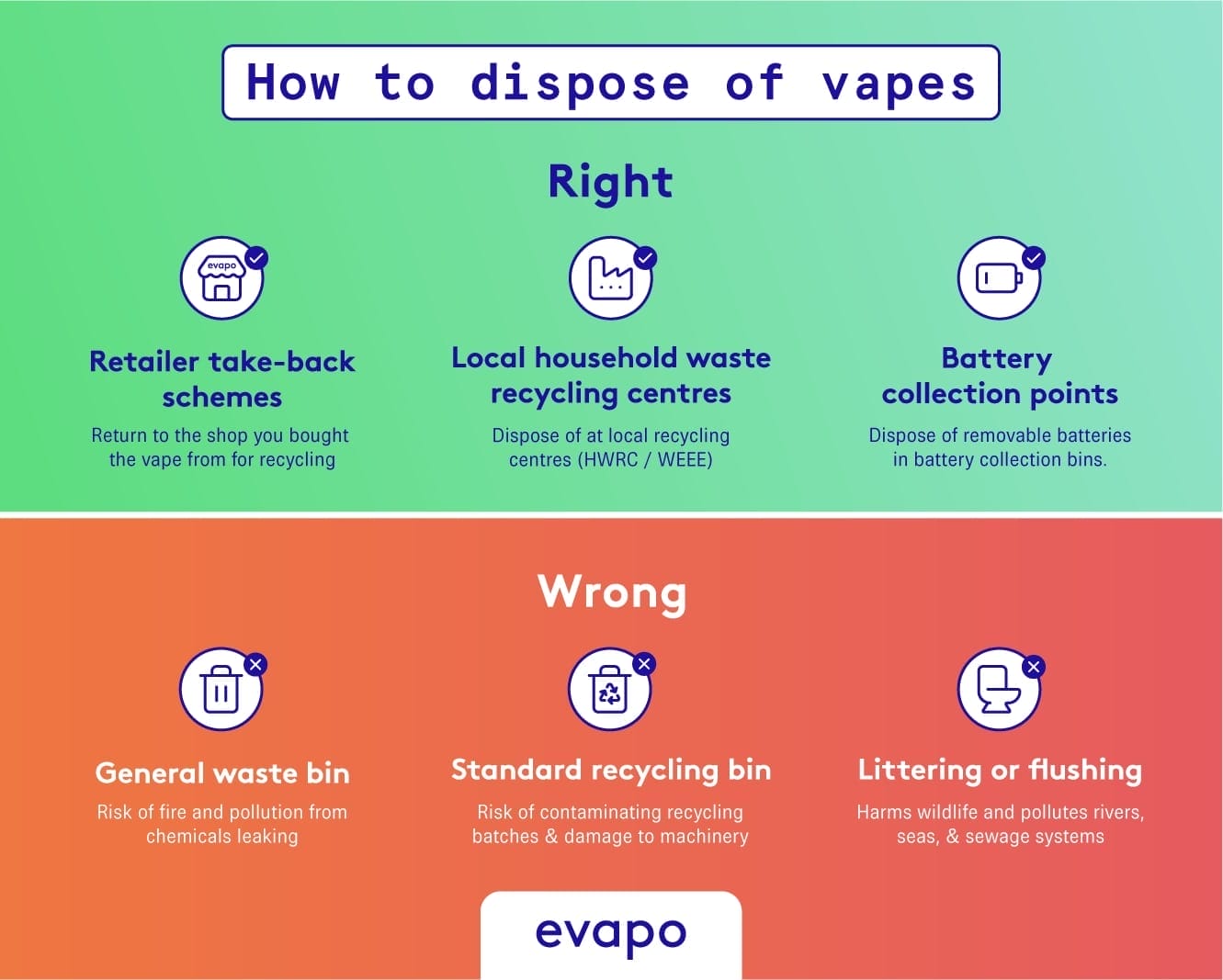
Infographic demonstrating the responsible disposal path for spent disposable vapes, emphasizing e-waste and battery collection points.
What Is a Disposable Vape? Fundamental Features and Design
A disposable vape is an all-in-one electronic vapouriser designed for single-use lifecycles. Once the internal e-liquid reservoir runs dry or the integrated battery depletes, the entire unit is replaced rather than refilled or rebuilt.
The primary appeal of these units lies in their zero-maintenance architecture. Traditional open-system vapourisers require users to monitor coil resistance, adjust wattage settings, replace saturated wicking material, and manually pour e-liquids into tanks. In contrast, a single-use vapouriser eliminates every manual configuration step. There are no access ports for e-liquid refills, no replaceable parts, and, in most traditional designs, no external buttons.
- DISPOSABLE VAPE
- Mouthpiece -> E-Liquid Wick/Tank -> Coil -> Battery
- (Draw Sensor at Base)
From an engineering perspective, these devices are designed around precise matching of power output to heating resistance. The internal battery voltage is calibrated to supply the exact current needed to heat the internal coil to an optimal vapourisation temperature without scorching the solution or producing an excessively hot aerosol.
What’s Inside a Disposable Vape? Anatomy and Hardware Components
While external form factors range from slim pen-style cylinders to pocket-sized rectangular boxes, the internal architecture across almost all modern devices relies on four core hardware assemblies.
- Mouthpiece
- ————–v————–
- E-Liquid Reservoir
- (Synthetic Cotton / Tank)
- ————–v————–
- Atomiser Coil & Wick
- (Mesh or Wire Element)
- ————–v————–
- Microphone / Draw Sensor
- (Pneumatic Switch)
- ————–v————–
- Lithium-Ion Battery
- ————–v————–
- Base Cap & Air Intake Hole
1. The Integrated Lithium Battery
At the base of the device sits a miniature, high-drain lithium-ion cell. This battery provides the direct electrical current needed to activate the heating coil. In smaller, single-lifecycle pens, this battery is intended to discharge completely alongside the exhaustion of the liquid chamber. In modern units holding larger fluid capacities, the base often features an integrated charging port (such as USB-C), allowing the battery to be recharged several times until the liquid reservoir is finally drained.
2. The Atomiser Coil and Wicking Material
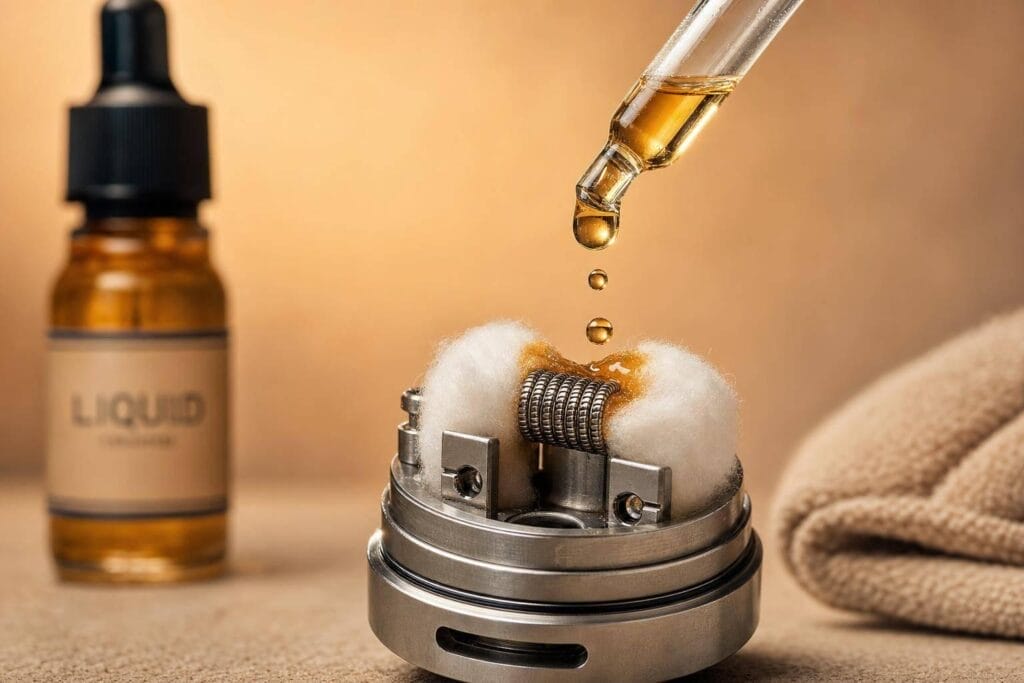
The atomiser is the thermal engine of the device. It consists of a resistive metal element—often arranged as a fine metallic mesh or a wound wire coil—wrapped around or encased within an absorbent wick. The wick absorbs e-liquid from the surrounding reservoir through capillary action, drawing it directly against the metal surface. When current passes through the coil, electrical resistance generates rapid heat, atomising the liquid held within the wick into an inhalable mist.
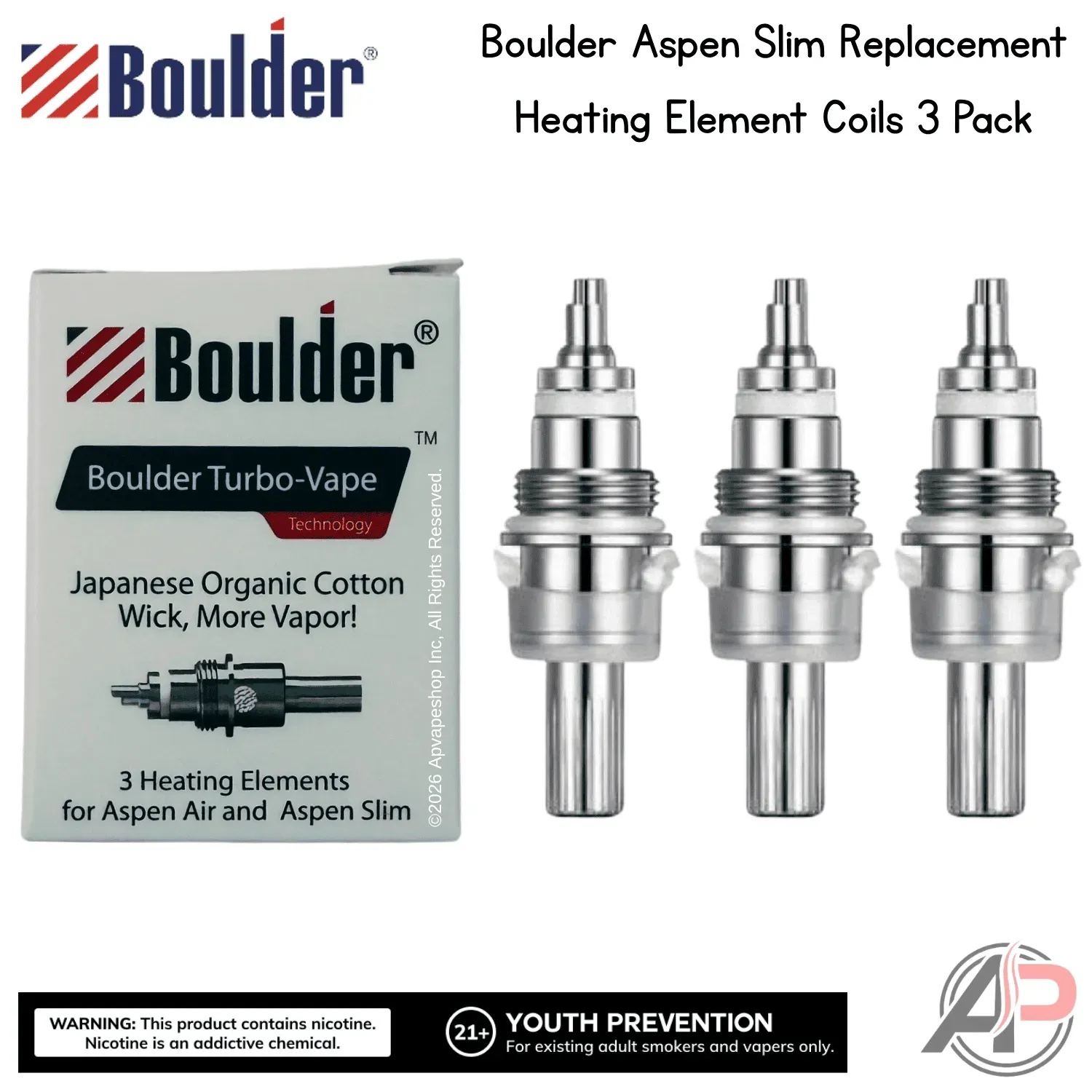
Close-up view of a vape atomizer coil with absorbent wicking material, illustrating the heating element
3. The Pneumatic Airflow Sensor (Microphone Switch)
Most single-use units operate without a physical firing button. Instead, they utilise an ultra-sensitive pneumatic pressure switch, frequently referred to in hardware design as a microphone sensor. This sensor contains a flexible membrane positioned along the internal airflow path. When you draw air through the mouthpiece, the drop in air pressure displaces the membrane, closing an electrical circuit that instantly directs power from the battery to the atomiser.
4. The E-Liquid Chamber and Airflow Chimney
Surrounding the coil assembly is the reservoir. In classic designs, this consists of a medical-grade synthetic sponge or fibrous polyfill saturated with flavoured fluid. In newer designs, manufacturers use open-tank reservoirs with gravity-fed wicking ports. Running straight through the centre of the fluid chamber is an isolated metal or heat-resistant plastic chimney that channels aerosol from the atomiser directly to the mouthpiece without liquid leaking into the vapour path.
| Component | Primary Function | Common Materials / Specifications |
|---|---|---|
| Power Cell | Delivers electrical current to heating element | Lithium-ion cell (3.7V nominal output) |
| Atomiser Coil | Converts electrical energy into thermal heat | Kanthal, Nichrome, or Stainless Steel mesh |
| Wicking Core | Feeds liquid to the heating element via capillary action | Organic cotton, synthetic silica, or porous ceramic |
| Draw Sensor | Detects inhalation to complete the electrical circuit | Pneumatic membrane pressure switch |
| Chamber / Housing | Protects internal components and stores e-liquid | Polycarbonate, aluminium alloy, silicone seals |
Understanding the E-Liquid: What Are You Inhaling?
The fluid contained within the device—commonly termed e-liquid, e-juice, or vapour solution—is a chemically formulated solution designed to aerosolise at relatively low boiling points. Unlike combustible tobacco, which burns organic plant matter to create smoke, an e-liquid relies on base carriers to suspend active ingredients and flavour molecules in an aerosol mist.
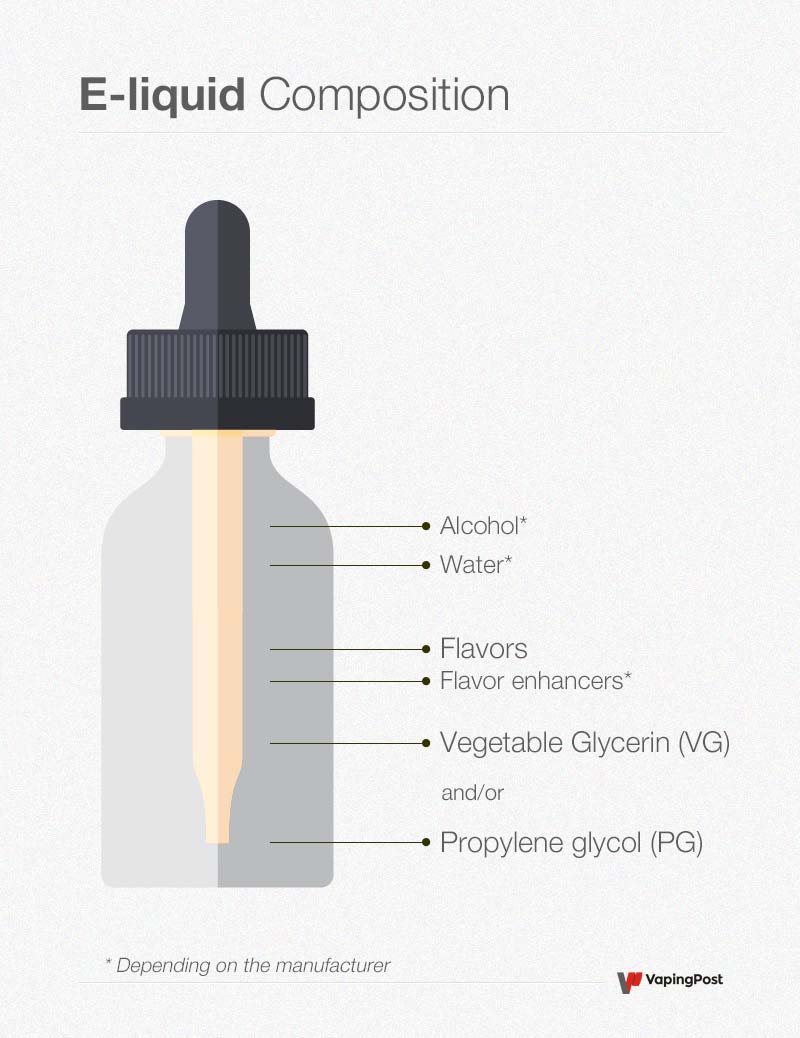
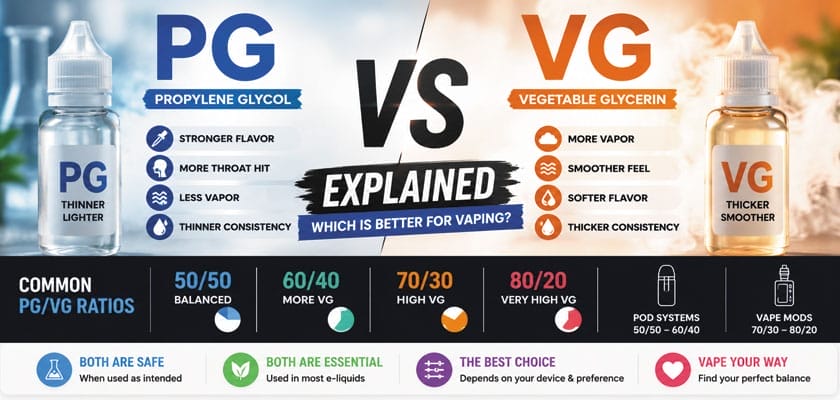
Infographic illustrating the chemical components of vape e-liquid, including Propylene Glycol, Vegetable Glycerine, Flavor Concentrates, and Nicotine.
- E-LIQUID COMPOSITION
- Propylene Glycol (PG) -> Throat hit & flavour transport
- Vegetable Glycerine (VG) -> Dense vapour & cloud body
- Flavour Concentrates -> Fruit, menthol, or beverage notes
- Nicotine / Nicotine Salts -> Active physiological compound
Propylene Glycol (PG)
Propylene glycol is a colourless, odourless synthetic liquid commonly used in pharmaceutical inhalers, food processing, and cosmetics. In vapourisers, PG serves as the primary flavour carrier. Because of its thin viscosity, it quickly saturates the wick and provides a sharp sensation at the back of the throat during inhalation (often referred to as 'throat hit').
Vegetable Glycerine (VG)
Vegetable glycerine is a thick, clear, naturally sweet liquid derived from plant oils (such as palm, soy, or coconut). VG is responsible for the visible density and volume of the aerosol cloud. Formulations strike a balance between PG and VG ratios to balance flavour clarity, wicking speed, and vapour density.
Flavour Concentrates
Manufacturers use food-grade and specialised aromatic flavour compounds to create complex taste profiles. These formulations span several main categories:
- Fruit Profiles: Single-note or blended profiles such as strawberry, watermelon, mango, and berry mixes.
- Menthol & Ice Varieties: Solutions combined with cooling agents (such as menthol or synthetic cooling agents like WS-23) that impart an icy sensation in the throat and mouth.
- Beverage & Confectionery Notes: Replications of sodas, energy drinks, coffees, desserts, and sweet confectionery treats.
- Traditional Profiles: Blends designed to emulate the earthy, dry profile of cured tobacco leaves.
Nicotine and Nicotine Salts
Many disposable vapour solutions contain nicotine. While traditional e-liquids historically used 'freebase' nicotine (which can feel harsh on the throat at elevated concentrations), single-use units almost universally employ nicotine salts.
Nicotine salts are created by combining pure freebase nicotine with an organic acid (such as benzoic acid or citric acid). This chemical reaction lowers the overall pH level of the solution, allowing higher concentrations of nicotine to be inhaled smoothly without causing severe throat irritation. Zero-nicotine variants containing solely PG, VG, and flavourings are also manufactured for individuals who enjoy the sensory ritual without the active stimulant.
How a Disposable Vape Works: Step-by-Step Vapourisation
The transition from a resting, pocketed device to active vapour production happens in milliseconds through a fluid-mechanical sequence.
Step-by-step diagram illustrating the vapourisation process in a disposable vape, from user inhalation to aerosol delivery.
- User Inhales at Mouthpiece
- Negative Air Pressure Created Inside Chamber
- Pneumatic Sensor Closes Electrical Circuit
- Battery Discharges Current to the Mesh Coil
- Coil Heats Rapidly (Thermal Conduction)
- E-Liquid on the Wick Reaches Boiling Point and Atomises
- Aerosol Mist Travels Up the Chimney to User
- Inhalation and Pressure Drop: The user draws air through the mouthpiece. This action forces air to enter through intake channels at the base of the device, creating an instantaneous drop in pressure (a vacuum effect) inside the casing.
- Sensor Activation: The pressure differential causes the pneumatic sensor membrane to flex. As it touches an adjacent contact point, it completes the low-voltage circuit between the battery and the atomiser coil.
- Thermal Energy Transfer: Current surges through the resistive metal coil. Within a fraction of a second, the temperature of the coil rises significantly.
- Phase Transition (Atomisation): The extreme heat rapidly boils the e-liquid suspended in the wicking material directly surrounding the coil. The liquid undergoes a rapid phase transition, turning from a viscous fluid into an aerosol suspension of microscopic liquid droplets.
- Vapour Delivery: As the user continues to inhale, ambient air entering the base mixes with the newly generated aerosol, cooling it slightly as it travels up the central chimney and out of the mouthpiece.
- Automatic Cut-Off: Once inhalation stops, internal pressure normalises. The sensor membrane springs back to its resting state, breaking the circuit and instantly stopping power delivery to prevent overheating or dry hits.
Operational Lifecycle: How to Tell When It Is Finished
Because single-use devices feature sealed enclosures, users cannot always see their remaining fluid levels. However, clear mechanical indicators signal when a unit has reached the end of its useful lifespan:
- A Burnt or Dry Taste: When the e-liquid in the wicking reservoir is completely exhausted, the heating coil begins to scorch the dry wicking material itself. This produces an acrid, harsh, and unpleasant taste, indicating the device must be discarded immediately.
- Flashing Indicator Light: Most devices house an LED at the base or front panel. If this light flashes repeatedly when you take a puff and no vapour is produced, the internal lithium cell has discharged below its operating voltage threshold.
- Diminished Vapour Production: A gradual drop in flavour richness and vapour thickness generally indicates that both the battery voltage is dropping and the liquid reservoir is running dry.
Environmental Impact, Battery Safety, and Australian Regulations
While single-use vapourisers offer clear user convenience, their construction presents notable waste management challenges that require responsible handling.
Exploded view diagram of a disposable vape showing all individual hardware components like mouthpiece, reservoir, coil, battery, and sensor.
- RESPONSIBLE DISPOSAL PATH
- Spent Vape -> DO NOT place in household rubbish/kerbside
- Community Battery Collection / Dedicated E-Waste Drop-Off
- Safe Lithium Extraction & Component Recycling
The Electronic Waste Problem
Every single-use vapouriser houses a functional lithium-ion cell, plastic casing, electrical wiring, and residual chemical compounds. When discarded into regular household kerbside rubbish, these units end up in landfill.
Lithium-ion batteries present severe fire hazards if punctured or crushed inside collection trucks and waste sorting facilities. Furthermore, discarded plastics and degraded heavy metals can leach into soil and waterways over time.
Safe Disposal Practices
To minimise environmental harm, spent units should never be placed in household recycling bins or standard general waste bins:
- Battery Drop-Off Points: Take spent units to designated community battery collection kiosks (often located at major supermarkets, community libraries, and local waste transfer stations) where lithium components can be isolated safely.
- Dedicated E-Waste Schemes: Check with your local council for hazardous waste collection days or dedicated electronic recycling centres capable of handling sealed devices containing batteries.
Australian Legal and Regulatory Context
In Australia, the regulatory landscape governing vapourisers is strictly enforced by the Therapeutic Goods Administration (TGA) and federal border authorities.
Under current Australian law, personal importation of all vapourisers is restricted. Therapeutic vaping products—intended exclusively for smoking cessation or nicotine dependence management—are accessible solely through pharmacies under medical practitioner or nurse practitioner supervision. The commercial sale of non-therapeutic, recreational single-use units from general tobacconists, convenience stores, and petrol stations is prohibited across all Australian states and territories.
Conclusion
A disposable vape functions as a highly integrated micro-engineering system. By marrying an automatic pneumatic draw switch, an optimised lithium power source, and a rapid thermal atomiser within a sealed enclosure, it delivers an instant, pre-metered aerosol with zero operational setup.
Understanding the mechanics, internal construction, and e-liquid chemistry of these units helps demystify how they work from the inside out. For those handling these devices, understanding the hardware also underlines the importance of mindful usage, regulatory compliance, and responsible end-of-life battery recycling.