What Is MTL Vaping? MTL vs DTL Explained Simply (2026 Guide)

What Is MTL Vaping? MTL vs DTL Explained Simply (2026 Guide)
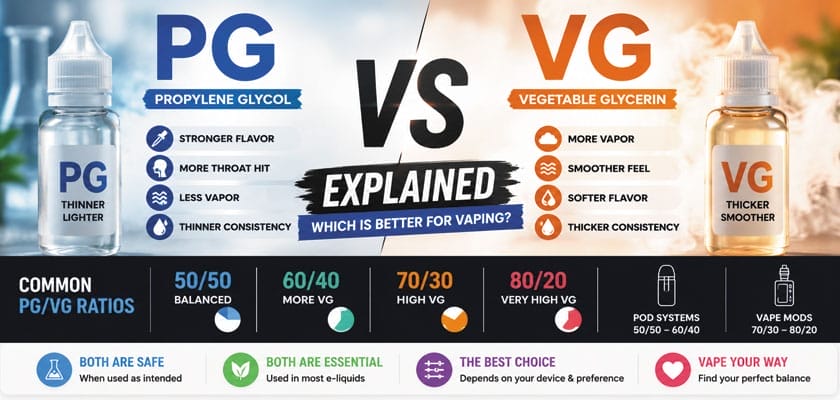
Visual representation comparing bottles or diagrams of Propylene Glycol (PG) and Vegetable Glycerine (VG), highlighting their different viscosities or properties.
Stepping into the world of vaping often means confronting an overwhelming wall of acronyms, technical terms, and hardware options. Among the most fundamental concepts every vaper encounters are two distinct inhalation styles: Mouth-to-Lung (MTL) and Direct-to-Lung (DTL). Understanding the mechanics behind MTL vaping and how it contrasts with DTL is crucial for selecting the right device, picking suitable e-liquids, and achieving a satisfying experience. Whether you are an adult smoker exploring alternatives or simply curious about how different devices function, understanding MTL vs DTL helps demystify the entire process. Choosing between a traditional mouth to lung vape setup and a high-powered cloud device comes down to your personal preferences regarding draw resistance, throat sensation, and vapour production. Finding the right MTL vape can transform an otherwise confusing transition into a straightforward, intuitive journey.
What Is MTL Vaping? The Mouth to Lung Vape Mechanics
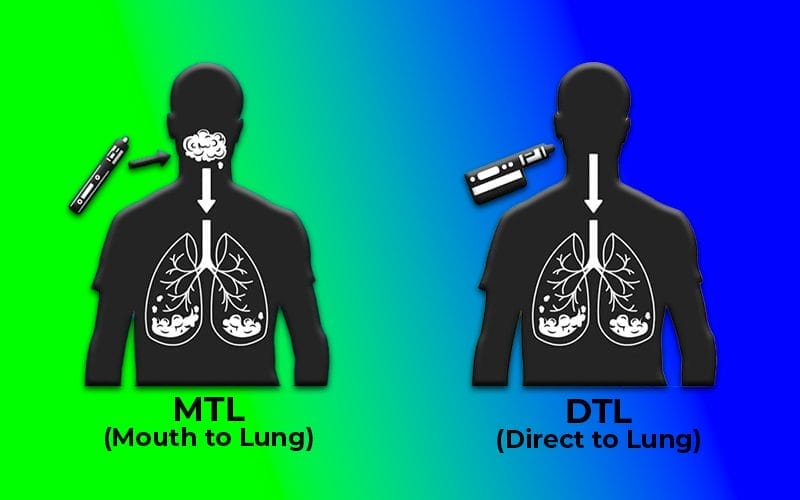
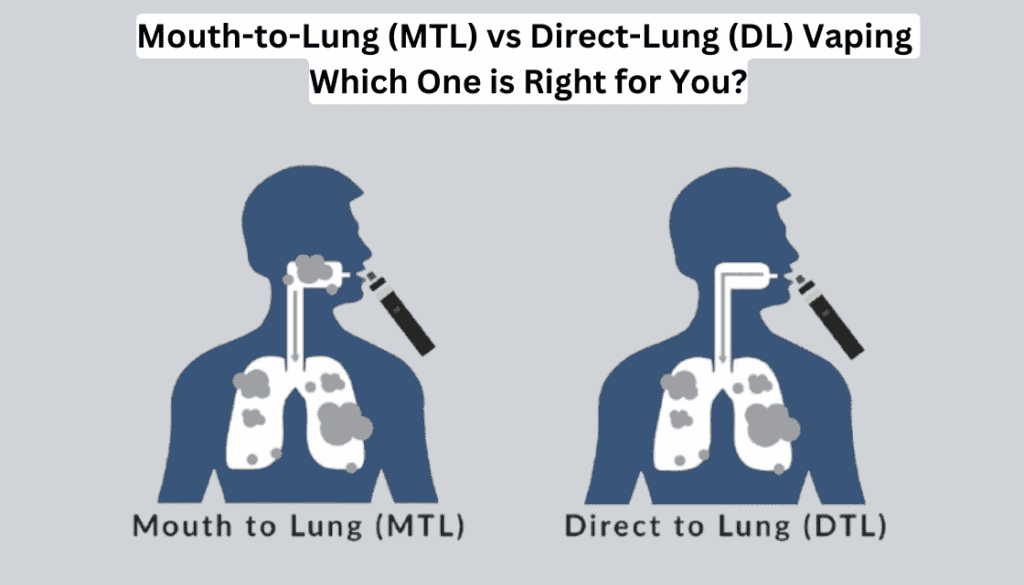
A visual comparison of Mouth-to-Lung (MTL) and Direct-to-Lung (DTL) vaping devices and their respective characteristics.
Mouth-to-Lung (MTL) vaping describes a two-step inhalation method that closely mirrors the physical act of smoking a traditional combustible cigarette or drinking through a narrow straw.
When using an MTL vape, you draw vapour slowly into your mouth first, hold it there for a brief moment, and then inhale it down into your lungs before exhaling.
Step 1: Draw vapour into mouth ➔ Step 2: Inhale into lungs ➔ Step 3: Exhale
This technique relies on restricted airflow. Because the air intake channels on an MTL atomiser or pod cartridge are narrow, the device creates noticeable resistance when you take a puff. You must actively use your facial muscles to pull the vapour into your oral cavity, rather than breathing straight through the mouthpiece.
Why MTL Feels Intuitive for Adult Smokers
For individuals transitioning away from smoking, MTL vaping provides familiar muscle memory and physical sensations:
- Restricted Airflow: The tight draw reproduces the resistance of a paper cigarette filter.
- Pronounced Throat Hit: The concentrated vapour delivers a crisp sensation at the back of the throat upon inhaling.
- Controlled Vapour Volume: The amount of vapour generated is modest and discreet, making it unostentatious in public settings.
- Familiar Rhythm: The two-stage draw allows users to take deliberate, measured puffs rather than deep, athletic breaths.
Because of these characteristics, entry-level starter kits, refillable pod systems, and disposable devices almost universally employ an MTL configuration.
What Is DTL Vaping? Direct to Lung Inhalation

A person demonstrating the Direct-to-Lung (DTL) vaping technique, inhaling vapor straight into the lungs in a single, continuous breath.
Direct-to-Lung (DTL)—often referred to as "straight-to-lung" or "sub-ohm" vaping—is a completely different approach to inhalation. Instead of gathering vapour in the mouth first, a DTL user inhales the vapour straight into the lungs in a single, continuous, deep breath, much like taking a breath through a snorkel or using a traditional shisha water pipe.
Single Step: Inhale vapour directly into lungs in one breath ➔ Exhale
To facilitate this direct inhale, DTL hardware features wide, open airflow channels with virtually no draw resistance. You do not need to pull or suck vapour into the mouth; instead, you simply breathe naturally through the wide-bore drip tip (mouthpiece).
Key Characteristics of DTL Vaping
- Unrestricted Airflow: Wide airflow slots allow substantial volumes of fresh air to mix with the atomised e-liquid.
- Substantial Vapour Production: DTL setups vapourise significantly more liquid per puff, creating dense, room-filling plumes of vapour ("cloud chasing").
- Smoother Inhalation: The throat hit is softer and more diffused because the vapour is diluted with higher airflow and lower nicotine concentrations.
- Warmer Vapour Profile: Higher electrical power heats the internal coil rapidly, creating a noticeably warmer draw that many hobbyists prefer for complex dessert or bakery flavours.
MTL vs DTL: Head-to-Head Comparison
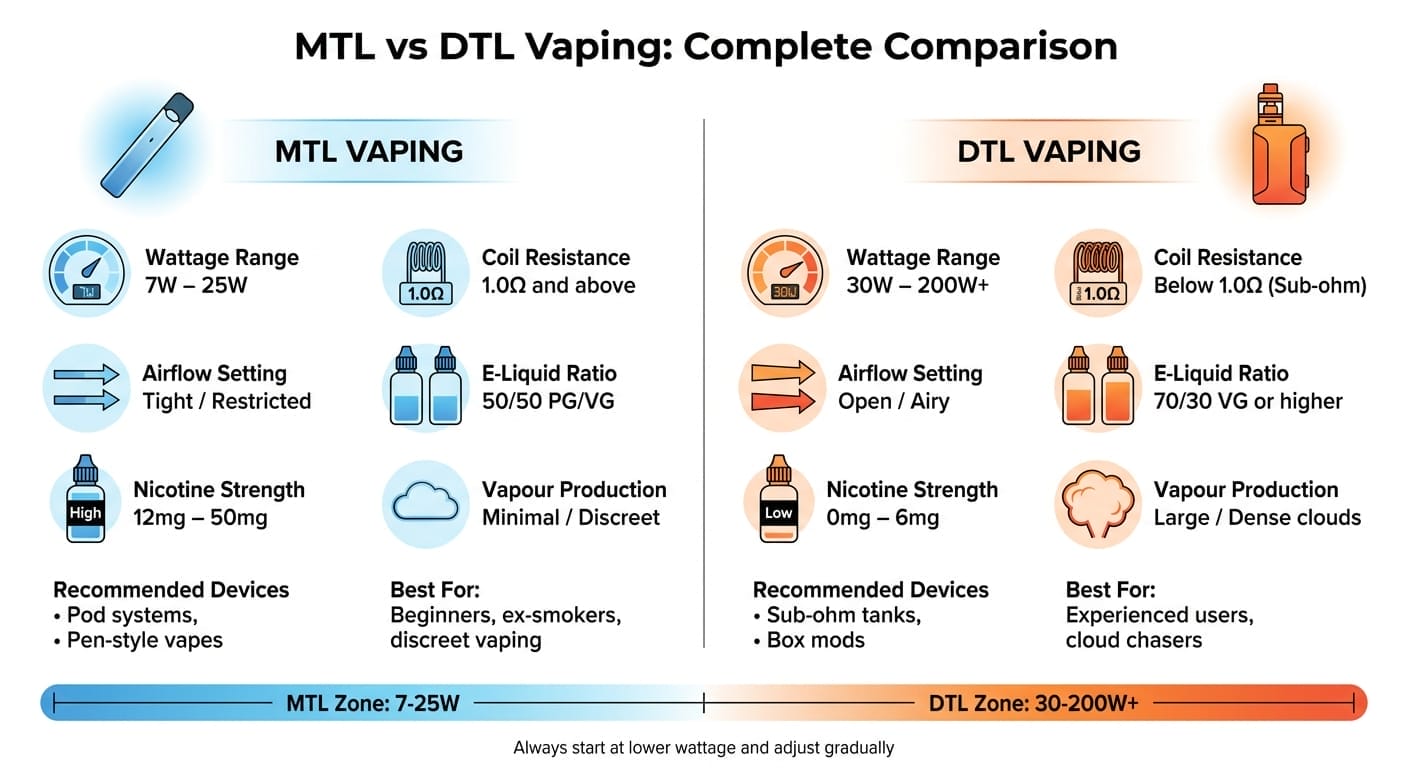
To understand how these two inhalation styles differ across day-to-day use, hardware requirements, and overall output, let us look at their core attributes side by side.
| Feature | Mouth-to-Lung (MTL) | Direct-to-Lung (DTL) |
|---|---|---|
| Inhalation Style | Two-step (Mouth, then lungs) | Single-step (Directly to lungs) |
| Airflow Resistance | Tight, restricted draw | Open, airy, unrestricted draw |
| Typical Coil Resistance | Higher resistance (commonly ≥ 1.0 Ω) | Sub-ohm (commonly 0.15 Ω to 0.5 Ω) |
| Typical Operating Power | Low wattage (typically 5 W to 20 W) | High wattage (typically 30 W to 100 W+) |
| Vapour Output | Low, discreet, minimal cloud | High, thick, voluminous clouds |
| Throat Hit | Sharp, noticeable, cigarette-like | Smooth, gentle, airy |
| E-Liquid Base Preference | Balanced PG/VG (e.g. 50/50 PG/VG) | High VG (e.g. 70/30 VG/PG or higher) |
| Nicotine Concentration Range | Moderate to high (Freebase or Salts) | Very low (typically 0 mg/mL to 6 mg/mL) |
| Device Form Factor | Slim pods, pens, compact kits | Larger box mods, sub-ohm tanks |
Technical Elements: Coils, Power, and Airflow
The physical differences between an MTL vape and a DTL device stem directly from electrical and aerodynamic principles.
Coil Resistance and Power Requirements
Electrical resistance in vape coils is measured in ohms (Ω). The resistance determines how much electrical current flows through the heating wire or mesh strip at a given voltage:
- MTL Coils (High Resistance): Coils rated at 1.0 Ω, 1.2 Ω, or 1.8 Ω use thinner wire or compact mesh strips. They require very little electrical power—usually between 8 W and 18 W—to reach optimal vapourising temperature. This low power output keeps the vapour cool to warm and prevents the small heating element from scorching.
- DTL Coils (Low Resistance / Sub-Ohm): Coils rated below 1.0 Ω (such as 0.2 Ω or 0.4 Ω) feature thicker wire or expansive multi-mesh grids with large surface areas. They need substantial power—often 40 W to 80 W or more—to heat up quickly.
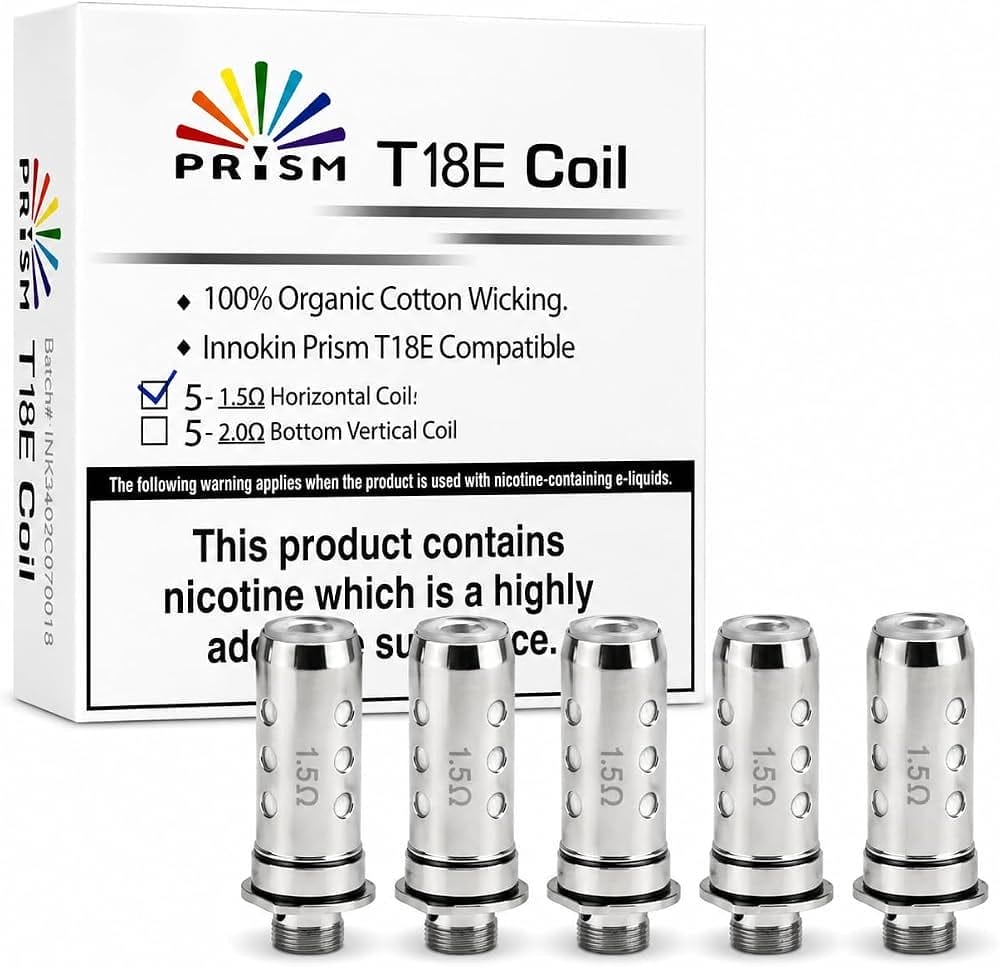
Close-up image of a high-resistance Mouth-to-Lung (MTL) vape coil, showing its thinner wire or compact mesh design.
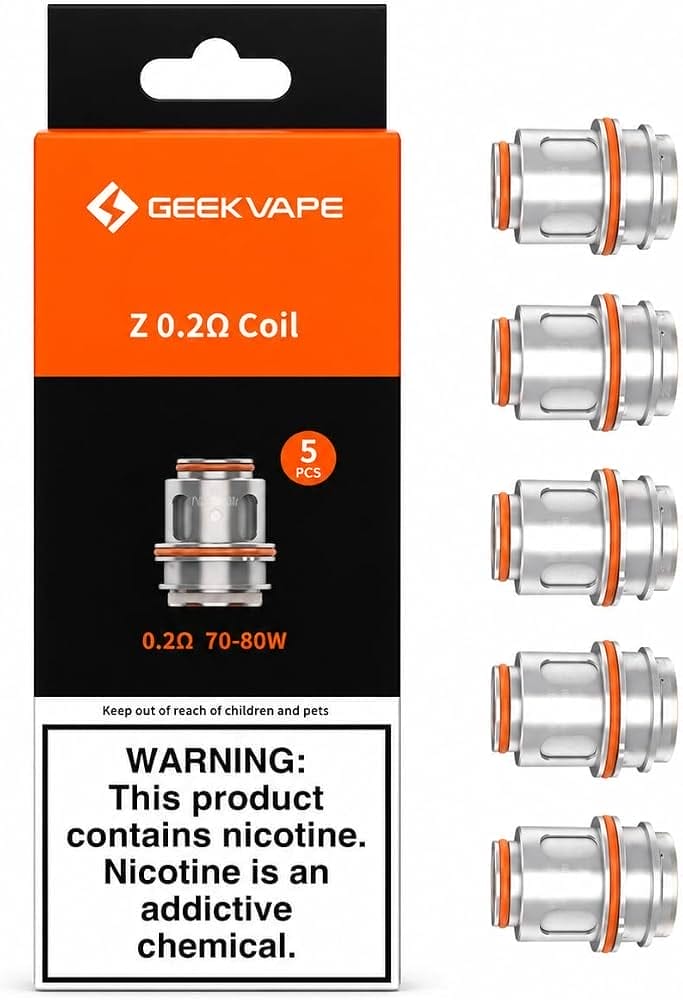
Close-up image of a low-resistance Direct-to-Lung (DTL) sub-ohm vape coil, featuring thicker wire or expansive mesh for higher power.
Airflow Engineering
Airflow controls both draw resistance and coil cooling:
- MTL Devices: Air enters through tiny pinholes (often 0.8 mm to 1.5 mm wide). The restricted air velocity cools the small coil efficiently while concentrating the flavour and throat hit.
- DTL Devices: Air enters through wide, adjustable perimeter slots. This massive volume of cool air prevents the high-wattage coil from overheating and expands the vapour into dense clouds.
Choosing the Right E-Liquid: PG/VG Ratios and Nicotine
Using the incorrect e-liquid blend in your hardware can lead to leaking, burnt coils, or an unpleasantly harsh throat hit. E-liquids consist of two primary base ingredients: Propylene Glycol (PG) and Vegetable Glycerine (VG).
Propylene Glycol (PG) vs Vegetable Glycerine (VG)
Close-up image of a high-resistance Mouth-to-Lung (MTL) vape coil, showing its thinner wire or compact mesh design.
- Propylene Glycol (PG) is a thin, runny liquid that carries flavour concentrates efficiently and delivers the sharp throat hit that replicates smoking.
- Vegetable Glycerine (VG) is a thick, viscous, sweet liquid that creates dense white vapour clouds upon heating.
Optimal E-Liquid Matching for MTL
Because MTL coils feature tiny wicking ports packed with tightly wound cotton, they require thinner e-liquids that saturate rapidly:
- Recommended Ratio: 50% PG / 50% VG or 60% PG / 40% VG.
- Why It Works: A 50/50 blend flows freely through small wicking channels, preventing "dry hits" (scorched dry cotton). The higher PG ratio delivers an authentic throat sensation without requiring high power.
- Nicotine Types: MTL devices pair seamlessly with both standard freebase nicotine and smooth, fast-absorbing nicotine salts.
Optimal E-Liquid Matching for DTL
Sub-ohm DTL tanks feature large juice intake ports and operate at elevated temperatures, requiring thicker formulations:
- Recommended Ratio: 70% VG / 30% PG, 80% VG / 20% PG, or maximum VG.
- Why It Works: High-VG liquid is thick enough to seal large wicking ports without flooding the atomiser chamber or causing leaks through the bottom airflow slots.
- Nicotine Guidelines: DTL users must stick to very low nicotine strengths (typically 3 mg/mL to 6 mg/mL, or zero nicotine). Because a DTL draw vapourises a vast volume of liquid in a single inhale, higher nicotine strengths will cause severe throat burning, coughing, and discomfort.
What About RDTL (Restricted Direct to Lung)?
In recent years, hardware manufacturers developed a hybrid category known as Restricted Direct to Lung (RDTL or RDL).
RDTL bridges the gap between MTL and DTL:
- The Inhale: You inhale directly into your lungs in a single step, but the airflow is noticeably restricted, feeling like breathing through a slightly pinched straw.
- The Hardware: RDTL setups typically use coils around 0.6 Ω to 0.8 Ω, running at moderate power levels (around 20 W to 30 W).
- The Experience: RDTL delivers more flavour saturation and slightly denser vapour than a classic MTL draw, while consuming less e-liquid and running cooler than a full sub-ohm DTL cloud setup. Many versatile pod kits include adjustable airflow switches specifically designed to let users toggle between tight MTL and loose RDTL.
Which Vaping Style Suits You Best?
Selecting between MTL and DTL comes down to identifying what you want to get out of your vaping experience.
- Are you looking for…
- Cigarette feel, discretion, and a firm throat hit? — ➔ Choose MTL
- Giant clouds, deep direct inhales, and warm vapour? ➔ Choose DTL
- A balanced middle ground with moderate vapour? — ➔ Choose RDTL
Choose an MTL Vape If:
- You are transitioning from smoking: The two-stage draw, restricted airflow, and distinct throat hit provide the most natural substitute for combustible tobacco.
- You value discretion: You want to vape without producing conspicuous clouds that draw unwanted attention.
- You prefer compact hardware: You want a lightweight device that slips easily into a pocket or small bag.
- You want simplicity: Most MTL pod devices feature automatic draw activation (no buttons required) and straightforward pre-built pods.
Choose a DTL Setup If:
- You enjoy cloud production: You find large, dense clouds visually satisfying and fun to produce.
- You prefer a smooth throat feel: You dislike the sharp sensation at the back of the throat and want an airy, smooth inhale.
- You enjoy hobbyist hardware: You like adjusting wattages, fine-tuning airflow controls, or customising external battery mods and rebuildable tanks.
- You use low-strength or zero-nicotine liquid: You are focused primarily on flavour profiles and vapour warmth rather than a sharp nicotine throat hit.
Practical Takeaway for Selecting Your Inhalation Style
Navigating the difference between MTL vs DTL does not have to be complicated. If you are starting out and want a familiar, mess-free experience that replicates a traditional cigarette draw, a dedicated mouth to lung vape kit running 50/50 e-liquid is almost always the right starting point. If your goals lean towards massive vapour clouds, warmer flavour profiles, and open, deep-breathing draws, a sub-ohm DTL setup will serve you far better.
Take stock of your personal priorities—discretion and throat hit versus clouds and warmth—and select your device and e-liquid accordingly. Understanding how airflow, coil resistance, and inhalation mechanics interact ensures you get a satisfying, reliable vape tailored directly to your needs.